How to Calculate Small Business Taxes: Income, Self-Employment, Sales
Get the basics of income, self-employment, and sales tax calculations for small businesses.

Understanding business taxes
If you want to know how to calculate tax for small business, start by separating taxes into buckets. Income tax and self-employment tax follow your business profit. Sales tax follows what you charge customers, not your profit.
Business taxes also depend on your structure. A sole proprietorship is taxed differently than an LLC that elects S Corp treatment or a C Corporation. Your structure changes what income counts, what forms you file, and which taxes you owe.
Finally, many owners must pay some taxes during the year. That is where estimated tax payments come in. If you skip them, you can face underpayment penalties even if you get a refund later.
- Income-based: income tax, self-employment tax
- Transaction-based: sales tax
- Structure-based: sole proprietorship, LLC, S Corp, C Corporation
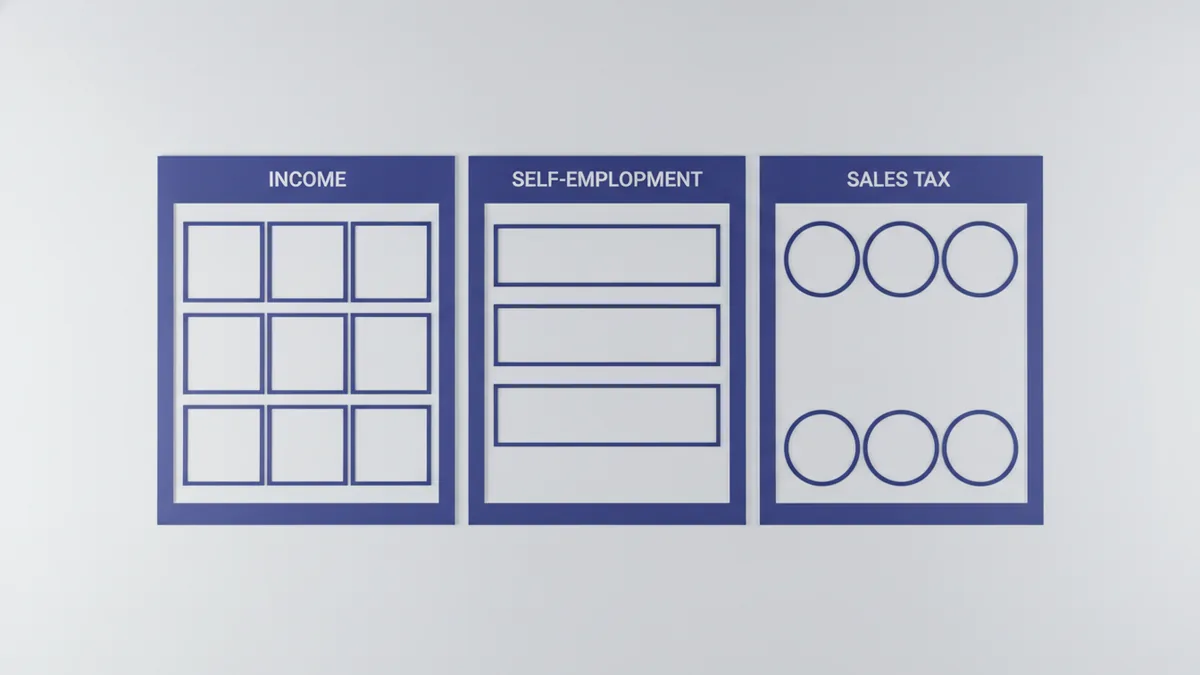
Types of taxes for small businesses
Most small businesses deal with three common types. Income tax is based on taxable income. Self-employment tax is based on net earnings for certain owners. Sales tax is collected from customers when your state requires it.
Two details trip people up. First, sales tax liability depends on when and where you have to collect. Second, some owners mix up taxes with business expenses when bookkeeping.
Here is a practical map you can use before you calculate anything. Identify what type each tax is, then connect it to your business structure and your sales situation.
| Tax type | What drives it | Who pays | Typical timing |
|---|---|---|---|
| Income tax | Taxable profit | You or the entity | Filed at year end |
| Self-employment tax | Net earnings of owner | Individual owner | Year end, with estimates |
| Sales tax | Customer transactions | Business collects, remits | Monthly or quarterly |

How to calculate income tax
To calculate income tax for a small business, you first calculate taxable income. Taxable income is usually your revenue minus allowable deductions and expenses. Then you apply the relevant tax rates.
The business structure changes the pathway. For a sole proprietorship, profit flows to your personal return. For an S Corp, profit also flows to shareholders, but wages may be treated differently. For a C Corporation, the corporation calculates income tax on its own return.
To make it concrete, assume your business has $120,000 of sales. You also have $40,000 in operational costs, $12,000 in employee wages, and $5,000 in business software and supplies. Your simplified net before taxes is $120,000 minus $40,000 minus $12,000 minus $5,000, which equals $63,000. Your taxable income may differ after adjustments and specific tax rules.
Next comes the tax math. If you are a sole proprietor, your federal income tax generally uses your personal brackets. If you run an S Corp, your income tax reporting is different, and you may also take payroll as wages. If you run a C Corporation, you calculate corporation income tax using corporate rules.
- Compute net profit (revenue minus deductible expenses).
- Subtract any deductions and credits you qualify for.
- Apply the correct tax rates for your structure.
- Account for estimated tax payments already made.
One more piece matters for tax planning strategies. Income can swing year to year. That is why many owners base estimated tax payments on realistic projections, not just last year’s result.

Estimating sales tax for your business
How to calculate sales tax for a small business depends on your state’s sales tax regulation. Start with the basic rate you must charge. Then confirm your taxable products or services, because not everything is taxed the same.
You also need to confirm when to charge tax. Common triggers include selling to customers in your state, having a required filing threshold, or meeting economic nexus rules. If you ship across states, the destination rules can matter too.
Here is the core calculation. Sales tax charged equals taxable sales multiplied by the sales tax rate. For example, if you sell $10,000 of taxable goods in a month and your combined rate is 6%, your gross sales tax collected is $10,000 × 0.06 = $600.
Now tie it to your books. Many owners ask, do you include sales tax in business expenses. In most cases, you should not treat collected sales tax as part of your business expenses. Collected sales tax is usually a liability you owe to the state.
- Money you collect from customers is generally a tax you remit.
- Only your own tax burden belongs in expenses, if any.
- Your bookkeeping should track collected tax separately from expenses.
If you are using a point-of-sale system or invoices, it should usually calculate the tax for each line item. Still, you should be able to reproduce the math for compliance checks and occasional returns or refunds.
Self-employment tax explained
Self-employment tax is essential for self-employment tax small business planning. It applies when an individual owner earns net earnings from working in their business. It supports Social Security and Medicare, even if you also pay income tax.
To understand self-employment tax, think of two layers. First, you calculate net earnings. Second, you apply the self-employment tax formula to that net amount, then account for any adjustments.
Here is a simple example. Suppose your net profit is $80,000. Your self-employment tax is based on net earnings, not gross sales. Many business owners pay a portion of this tax through estimated tax payments, then finalize it on their yearly filing.
The rate mechanics and the wage-base limit can change over time. Because those details can matter, you should use the current IRS instructions for the exact calculation steps. You can also review the general IRS guidance on self-employment tax to confirm what counts and how to compute it.
Also, self-employment tax interacts with deductions. For example, there is often an “above-the-line” adjustment tied to half of the self-employment tax. That does not eliminate the tax, but it can reduce income tax by lowering taxable income.
Tax deductions and expenses
Business tax deductions reduce taxable income, so they are central to business tax deductions planning. The basic idea is straightforward. If an expense is ordinary and necessary for your trade or business, it may be deductible.
Operational costs commonly qualify. Examples include rent, utilities, office supplies, software subscriptions, and marketing. Employee wages usually qualify too. If you have independent contractor expenses, those can also be deductible when properly documented.
You will also see questions like how do i include sales tax in business expenses. If your business purchases items for resale, sales tax paid to suppliers is often treated differently from tax collected from customers. In many cases, sales tax you pay on purchases is not an income tax deduction itself. It depends on state rules and how the transaction is handled in your books.
Track expenses carefully and separate them into categories that match your accounting records. The better your records, the easier it is to support your deductions if the IRS tax filing requirements get reviewed.
- Operational costs and software tools
- Employee wages and benefits
- Contractor pay with proper documentation
- Business travel and meals under the allowed rules
- Insurance and professional fees
Choosing the right business structure
Choosing the right business structure can significantly impact tax rates and liabilities. The structure determines who reports profit and who pays tax. It also affects whether you owe self-employment tax on your business earnings.
A sole proprietorship is simple to start and often reported on a personal return. An LLC is more flexible, because it can be taxed as a disregarded entity, an S Corp, or a C Corporation. An S Corp can reduce self-employment tax on some income by splitting it between wages and distributions. A C Corporation generally pays corporation tax at the entity level and later taxes can apply to dividends.
You should also consider state-specific items like franchise tax. Some states charge franchise tax based on entity type or income levels. Those costs can change the true “all-in” tax burden for your business.
When you evaluate structures, connect tax planning to your goals. If you are reinvesting profits, rates may matter differently than if you plan to distribute most cash to yourself. If you expect large growth, you may also consider how sales volume will affect sales tax compliance.
- Estimate expected profit and salary needs for the first year.
- Estimate sales tax obligations based on your product and customer locations.
- Model the impact of structure on income tax and self-employment tax.
- Include state fees like franchise tax in your comparison.
If you are wondering how to calculate sales projections for a new business, it links directly to your tax planning. Sales projections drive taxable income. They also drive cash needs for estimated tax payments and sales tax remits.
Quick example to tie everything together
Imagine you expect $250,000 in annual sales. Your estimated deductible expenses are $160,000, so projected net profit is $90,000. If you are an owner who must pay self-employment tax on net earnings, that $90,000 becomes a key input. If you also have taxable sales and a 6% rate, your collected sales tax can be about $15,000 before credits, refunds, or exemptions.
You would then plan estimated tax payments throughout the year. At year end, you file the right forms for your structure and reconcile what you already paid.
For more detailed IRS guidance, see the IRS instructions for self-employment tax and the relevant tax forms for your situation.
the IRS Small Business and Self-Employed Individuals Tax CenterFrequently asked questions
- How do I calculate tax for a small business in plain terms?
- Start with profit for income tax and self-employment tax. Then calculate sales tax from customer transactions using the correct rate and rules for your state.
- How do I calculate income tax for a small business?
- Compute taxable income from revenue minus allowable deductions. Then apply the correct tax brackets or corporate rules based on your business structure.
- Do I include sales tax in business expenses?
- Usually no. Sales tax you collect from customers is typically a liability to remit. Sales tax on purchases depends on how the transaction is handled and how your books categorize it.
- How do I calculate sales tax for my business?
- Multiply taxable sales by the sales tax rate you must charge. Confirm when you must collect based on your customer locations and state rules.
- What is self-employment tax for small business owners?
- It is a tax on your net earnings as an individual owner. It funds Social Security and Medicare, and it is often paid through estimated tax during the year.
- Does choosing an LLC, S Corp, or C Corporation change taxes?
- Yes. Structure affects how profit is taxed, which forms you file, and how self-employment tax applies. It can also change state costs like franchise tax.
Related reading

How CRM Improves Business Performance — From Sales to Service
See how CRM can help your team serve customers and work smarter.

Find Consulting Jobs (From Search to Offer)
Find consulting roles, build strong applications, and prepare for interviews.

Start a Property Management Business (From First Steps to Growth)
Build a property management firm with the right niche, rules, tools, and client plan.