What Does a Consulting Firm Do? Roles, Services, and Operations
Learn what consulting firms do, how they work, and what to expect from services, fees, and careers.

What a consulting firm is and what it does
A consulting firm gives expert advice to businesses with hard, real problems. It turns messy issues into clear next steps. If you ask, “what does a consulting firm do,” this is the core answer.
What does consulting mean in business? It means using skill and a method to improve choices. It is not guesswork. It is analysis plus action planning.
What does a consulting business do in practice? It studies your work, then recommends fixes. Some work ends at a plan. Some work supports change while you ship new ways of working.
- Get the real problem and the goal
- Check data, processes, and limits
- Share a plan with owners and timing
- Help teams apply the plan

How consulting firms operate inside client organizations
Most consulting starts as a project. The firm agrees on scope, cost, and “done” steps. Then it runs a short discovery phase to learn what is happening.
Consultants collect facts fast. They use interviews, process maps, and key metrics. They also watch how decisions get made today. Then they test what might cause the issue.
Work then moves into a recommendation phase. A firm builds options, estimates impacts, and picks a path. This is where project management keeps things on track.
Finally, many firms support delivery. That can mean workshops, training, or hands-on help for new workflows. It can also mean hands-off coaching, depending on your needs.
- Discovery: interviews, data review, and goal setting
- Analysis: find root causes and compare options
- Recommendation: share steps, cost, and timing
- Delivery support: help adoption and roll out changes

Types of consulting services you will see most often
Consulting services come in a few common types. Firms may focus on one type. Others blend multiple types for one client need.
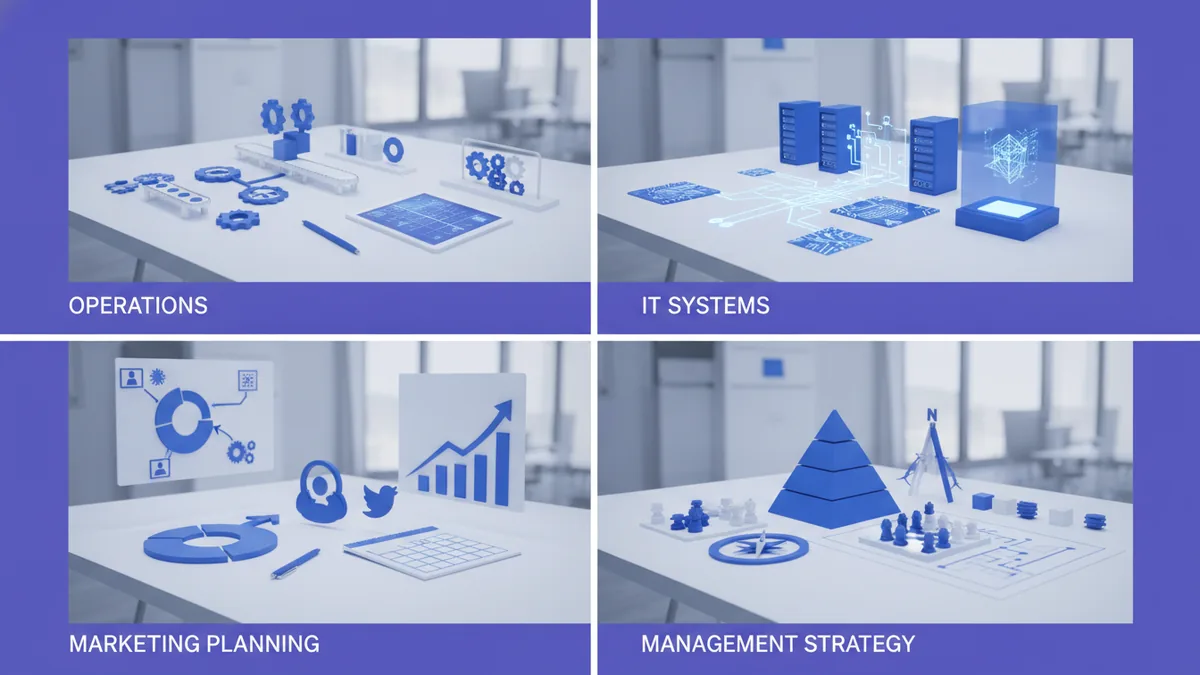
Strategy consulting helps with business strategy, meaning where to play and how to win. Management consulting targets how the business runs day to day. It can cover roles, rules, and how leaders decide.
IT consulting supports system work and data tasks. It may help with new tools, safer setups, or cleaner data paths. Marketing consulting focuses on demand, messaging, and channel choice.
Operational consulting aims at faster work and lower waste. It often targets operational efficiency, meaning better output with less effort. You see this in process change and control updates.
| Consulting type | Typical goal | Common outputs |
|---|---|---|
| Strategy | Pick direction | Plans, roadmaps, and investment cases |
| Management | Improve ways of working | Ways to run teams, governance, and roles |
| IT | Enable better systems | System design, data plan, and rollout steps |
| Marketing | Grow demand | Channel plan, tests, and KPI tracking |
| Operations | Reduce waste | Process fixes and a new measure plan |
Why companies hire consulting firms
Companies hire consultants for three clear reasons. They need skills they lack. They also want a fresh view from outside. They often want faster results too.
Special skill is a big driver. A firm may know your industry and also know the method to solve it. That saves time and cuts trial and error. It can also reduce big mistakes.
Next comes objectivity. Internal teams can feel pressure from politics or old bets. A consulting team can ask blunt questions and test claims. That can improve client relationships across leaders.
Speed matters most in tight windows. Many deals use a fast discovery phase and then fast workshops. They turn a long debate into a clear plan you can act on.
- Close skill gaps without long hiring cycles
- Use proven methods for business strategy and rollout
- Add capacity when deadlines loom
- Train teams so change sticks

How consulting firms charge and earn revenue
Consulting firms earn money in several ways. The model depends on scope and risk. It also depends on how clear the work can be.
Hourly billing is common. You pay for time spent on tasks. This fits work where the path changes as new facts appear. Still, good deals set caps and weekly updates.
Fixed fee deals also exist. You pay one price for set deliverables. This works best when scope is tight. You must define “done” clearly.
Retainers are another option. A retainer pays for steady access to help. Some firms use this for ongoing advice and issue support. It can also cover a set number of days.
Some contracts tie pay to results. That is performance based, meaning fees link to agreed metrics. It can work well, but only with clear baselines and measurement rules.
| Revenue model | Good fit for | Risk control |
|---|---|---|
| Hourly billing | Research and deep analysis | Set rates, caps, and clear reports |
| Fixed fee | Clear deliverables | Lock assumptions and accept steps |
| Retainer | Ongoing help | Agree on service levels and tasks |
| Performance based | Measurable outcomes | Agree on metrics, baselines, and proof |
Consulting careers: skills, roles, and what to expect
Consulting careers fit people who can learn fast and explain well. Strong analytical skill helps you spot patterns in data. It also helps you test options and build logic.
Communication is just as important. Stakeholders need clear points and practical next steps. They do not want long math or vague slides. You must write and speak with focus.
Adaptability matters in daily work. Engagements change as facts shift. New data can flip a recommendation. Teams need calm thinking under pressure.
Some roles are more technical. A consulting engineer helps plan and ship tech work. They may design systems, manage handoffs, or test integrations. They also help with risk and rollout steps.
Many candidates ask about recruiting timing. When does consulting recruiting start? Often it starts early in the school year. Some firms run internships and campus talks long before full-time offers.
- Analyze problems with clear logic
- Write and speak in short, clear form
- Adapt when facts change mid project
- Stay steady in busy, varied weeks
Common challenges when working with consultants
Working with consultants can feel hard in three areas. First is client expectations. Second is time fit. Third is implementation after the report.
Expectations need tight scoping. If you want both a plan and full build work, say so early. If you only want advice, say that too. Then everyone can track the same “done” goal.
Timelines often slip when data access is slow. Approvals can also stall. A good team tracks milestones and risks every week. It also sets a clear decision path.
Implementation is where value can break. Teams fail when they treat advice as a document. Success comes when an owner applies the plan. It also needs training and new measures.
Ask what will change next week, not only what will be recommended.
Some firms also do pro bono consulting for community needs. It still uses the same discipline: learn, plan, then act. The work may be smaller, but the method stays real.
FAQ: quick answers about what consulting firms do
These answers help you understand “what does a consulting company do” in plain terms. They also cover common doubts about consulting work and roles.
| Question | Answer |
|---|---|
| What does consulting do? | It uses analysis to produce actions your team can apply. |
| What does consulting mean? | It means expert support to improve choices and results. |
| What does a consulting producer do? | They coordinate delivery, schedules, and scope alignment. |
| What does a consulting business do? | It runs projects that deliver plans, plus help for adoption. |
You may also wonder about technical roles. A consulting engineer role often means tech design and safe rollout. Other roles may focus on process change and team enablement.
Some searchers ask about taxes, like “does consulting qualify for qbi.” That depends on your facts and local rules. Talk with a tax pro for a correct answer.
Frequently asked questions
- What does a consulting firm do for a business?
- A consulting firm analyzes a problem and recommends actions your team can implement. It may also help with workshops, tools, and change support.
- What does consulting mean in business?
- In business, consulting means applying structured methods and expertise to improve decisions or outcomes. It usually starts with discovery and ends with a deliverable plan.
- What consulting services mean in practice?
- Consulting services are the specific areas of help, like strategy, IT, marketing, or operations. Each service comes with common outputs and a defined engagement scope.
- How do consulting firms make money?
- Consulting firms often use hourly billing, fixed fees, retainers, or performance-based contracts. The best model depends on how clear the deliverables are.
- What skills do you need for a career in consulting?
- You typically need strong analytical skills, clear communication, and the ability to adapt quickly. Comfort with ambiguity is also common in consulting work.
- What are common challenges when hiring consultants?
- Typical issues include unclear expectations, timeline slippage, and weak implementation after the report. These risks drop when scope and ownership are defined early.
Related reading

Understand Insulin’s Role in Metabolism (Key Processes)
See how insulin guides glucose, fat, and protein use in the body.

Consulting Company Revenue Models: How Pricing Works and Why
Understand how consulting fees work, from hourly rates to value pricing.

Business Credit Explained: What It Is and How to Improve It
Understand business credit, what lenders see, and how to improve your score.