How to Make a Marketing Strategy That Fits Your Goals
Build a marketing strategy plan with goals, research, and a smart marketing mix.

Understanding marketing strategy (and why it beats random tactics)
A marketing strategy is a long-term plan to promote your products or services to a target audience. It connects what you want to achieve with how you will reach people and why your offer should win. Without that link, campaigns become one-off actions with no clear path to growth.
Good marketing strategies align with overall business goals like revenue, retention, or market expansion. They also use data-driven marketing so decisions are based on evidence, not hope. That means you track performance metrics and adjust quickly when results differ from expectations.
If you are figuring out how to make a marketing strategy, start by thinking in outcomes and choices. You are deciding which customers matter, what you will say to them, and where you will reach them. Then you build tactics that support those decisions.
- Strategy: direction and choices that guide the next few quarters
- Tactics: specific actions like ads, email, or events
- Measurement: performance metrics that tell you what works
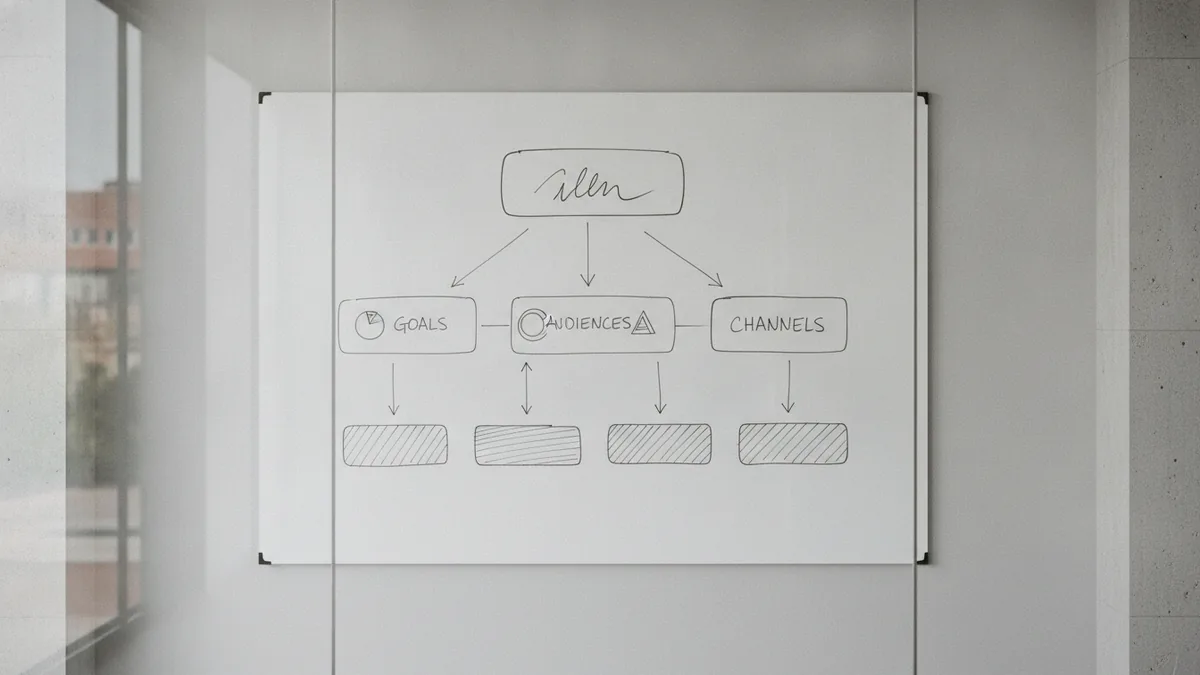
Steps to create a marketing strategy plan that stays on track
When you ask how to make a marketing strategy plan, you really ask how to build something you can run. A useful approach is to move from research to goals, then to audience and competitors. Finally, you turn those insights into a marketing mix you can execute.
Use these steps to structure your work. They also work as a template for how to make a marketing plan for small business, where time and budget are tighter. The key is to keep each step clear enough that you can make decisions.
- Run market research to understand demand, channels, and customer needs.
- Set SMART goals so you know what success means.
- Define your target audience with clear customer personas.
- Do competitor analysis to spot gaps and patterns.
- Develop the marketing mix for product, price, place, and promotion.
- Plan monitoring so you adjust based on results.
As you build your plan, write decisions in plain language. For example, decide which channel gets most budget, and why. Then your team can execute consistently without guessing.

Conducting market research to reduce guesswork
Market research answers what customers want, how they buy, and why they choose one option over another. It also reveals which channels they trust and when they are most likely to act. This is where your strategy becomes specific instead of generic.
Start with a few focused inputs. Review sales data if you have it. Look at search demand and top-ranking pages for your offer. Then talk to customers and sales prospects to learn the real objections.
When you document your research, aim for insights you can act on. You want patterns like common problems, preferred features, and price expectations. That becomes the raw material for brand positioning and messaging later.
- Demand signals: search trends, web traffic sources, inquiry volume
- Customer voice: interviews, support tickets, sales call notes
- Channel clues: where customers discover and compare options
- Buying process: timelines, triggers, decision criteria

Setting measurable objectives with SMART goals
Objectives turn your marketing strategy into something you can manage. They should be measurable so you can tell if your spend is paying off. This is where SMART goals help: Specific, Measurable, Achievable, Relevant, and Time-bound.
Instead of “increase awareness,” use a goal tied to a metric and a deadline. For instance, “Grow qualified leads from organic search by 25% in 90 days.” That forces clarity on the baseline and the target.
Pick a small set of objectives that connect to your business goal. If your business goal is revenue growth, choose metrics that predict sales. If your goal is retention, choose metrics that reflect repeat use and customer satisfaction.
| Business goal | Marketing objective example | Performance metrics to watch |
|---|---|---|
| Revenue growth | Increase demo requests by 20% in 60 days | Conversion rate, cost per lead, demo-to-close rate |
| Retention | Reduce churn by 10% over 120 days | Repeat purchase rate, churn rate, support ticket trends |
| New market entry | Reach 500 qualified sign-ups from a new region | Qualified signup rate, pipeline created, CAC by region |
Make sure each objective maps to one or two tactics. If a goal has ten drivers, you will struggle to learn what caused results.
Identifying your target audience and building clear personas
Your target audience is the group most likely to buy from you now. It is not “everyone who might be interested.” Narrowing your focus improves messaging and makes channel choices easier. It also helps your team avoid wasted spend.
To build customer personas, start from real behavior and real constraints. Look at who already buys, who asks for quotes, and who abandons the process. Then segment by needs, use cases, and decision drivers.
A strong persona includes goals, pain points, and what “good” looks like. It also includes buying barriers like budget limits or timing issues. That becomes your content and offer strategy.
- Persona profile: role, industry, budget range, and typical timeline
- Pain points: the problem they want to solve and why it matters now
- Decision factors: what they compare, fear, or verify before buying
- Channel habits: where they learn, evaluate, and trust information
When your personas are clear, your messaging can stay consistent across channels. It also makes it easier to create assets like a landing page or a marketing video for my business that answers buyer questions.
Analyzing competitors to sharpen brand positioning and your UVP
Competitor analysis shows how the market currently works. You learn what claims competitors make, how they price, and which channels they dominate. You also spot gaps where customers feel underserved.
Do not only compare features. Compare outcomes and messaging. A customer chooses based on perceived value, not a checklist of product traits. That is why your unique value proposition matters.
Your unique value proposition (UVP) is the reason a buyer should pick you. It connects who you serve with the specific benefit you deliver. When you know your UVP, you can differentiate your offer without sounding random.
- List direct and indirect competitors across the full buying journey.
- Score their positioning using claims, proof, and customer language.
- Compare pricing and packaging to understand value signals.
- Find openings where customers complain or where benefits feel unclear.
- Translate gaps into your UVP and proof points.
For example, if competitors lead with price but customers worry about quality, you can position around reliability and clear results. The strategy stays coherent because your messaging follows from real insights.
Developing the marketing mix: product, price, place, and promotion
The marketing mix is how you execute your strategy. It covers the Product, Price, Place, and Promotion choices that shape customer experience. When these pieces work together, performance improves because you reduce friction at every step.
Start with the customer persona and ask what will make them say “yes.” Then adjust each mix element. Product might mean a clearer offer and better onboarding. Price might mean packaging that matches budget reality.
Place is where your offer is found and purchased. Promotion is how you create awareness and persuade action. If you are planning a launch or a how to make marketing strategy for new product, this section is where you align everything around the moment of discovery and purchase.
| Marketing mix element | What to decide | Example choices |
|---|---|---|
| Product | Offer, features, onboarding, guarantees | Tiered plans, implementation guide, trial length |
| Price | Pricing model, discounts, packaging | Monthly vs annual, value-based bundle, set-up fee rules |
| Place | Distribution channels, sales process, delivery | Direct sales, partner channel, ecommerce checkout |
| Promotion | Channel mix, messaging, content formats | Search ads, email nurture, webinar, short product video |
For promotion, plan content that answers buyer questions. If you want to build a marketing video for my business, map the video to one persona’s decision moment. A short explainer can show outcomes and proof. A longer demo can show how it works in practice.
Finally, design your feedback loop. Track performance metrics for each mix element and document what improves results. Then update your plan for the next cycle.
Monitoring performance and adjusting your strategy over time
Marketing strategy is not set-and-forget. It is a cycle of plan, measure, learn, and improve. Data-driven marketing means you compare results to your SMART goals and decide what to change.
Set review points in your calendar. For example, check leading indicators weekly and outcome metrics monthly. Leading indicators might include click-through rate and conversion rate. Outcome metrics might include qualified leads, pipeline created, or churn changes.
When you adjust, do it with a hypothesis. If conversion is low, test messaging or landing page clarity. If leads are high but sales are low, focus on offer fit and qualification. This keeps changes grounded in evidence.
- Use baselines: measure before you change anything
- Test one variable: change one thing per experiment
- Document learning: write why a test worked or failed
- Keep the strategy: update tactics, not core choices
With steady monitoring, your marketing plan becomes sharper each quarter. You do not just run campaigns. You build a system that improves over time.
Frequently asked questions
- How do I make a marketing strategy for my business from scratch?
- Start with market research, then set SMART goals. Next, define your target audience with personas and do competitor analysis. Finish by choosing your marketing mix and plan how you will measure results.
- What is the difference between a marketing strategy and a marketing plan?
- A marketing strategy is your long-term direction and main choices. A marketing plan is the practical roadmap that turns those choices into actions, timelines, and budgets.
- How do I make a marketing plan for small business with limited budget?
- Choose one or two goals, then focus on the channels that reach your personas fastest. Use performance metrics to prioritize what works and cut what does not.
- How do I create SMART goals for marketing?
- Make each goal specific about the metric and the timeframe. Ensure it is achievable with your budget and team capacity, and relevant to your business outcome.
- How do I analyze competitors without copying them?
- Compare positioning, messaging, pricing, and proof, then identify gaps customers care about. Use those gaps to shape your unique value proposition and improve your own offer.
- How can I make a marketing video for my business that converts?
- Map the video to a single persona decision moment. Focus on outcomes, show proof, and include a clear next step that matches your funnel stage.
Related reading

Start a Mobile Drug Testing Business (Without a Lab)
Build a mobile testing service with sound training, lab links, and clear pricing.

Start a Business with a Problem Worth Solving
Turn a useful idea into a business with clear steps, sound research, and steady resolve.

Loft Conversion Timelines — What Affects the Build
Typical build times range from four to twelve weeks, plus planning and setup.